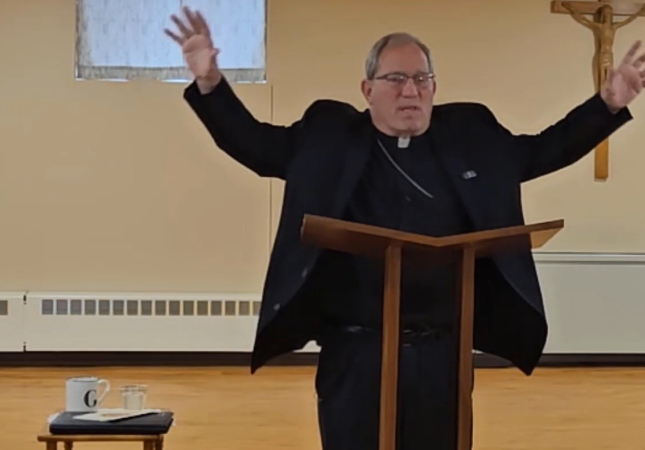
SAGINAW — On Friday at the Cathedral of Mary of the Assumption, Bishop Robert Gruss invited the faithful to reflect on one of the most difficult — and most transformative — aspects of the Christian life: surrendering completely to God.
Speaking at the monthly First Friday gathering at the Cathedral of Mary of the Assumption, Bishop Gruss began by mentioning how Pope Leo XIV recently offered a profound reflection about the purpose of Lent. This catechesis was shared with the Roman Curia after the Pope's Lenten retreat. "Pope Leo reminded those present that Lent is not a season for spiritual self-optimization. It is not about constructing better habits merely for the sake of personal improvement. Rather, it is about surrender. True conversion begins when we allow Christ to act within us and through us. The Christian life is not a project we manage, but a grace we receive and cooperate with."
The challenge of surrender
The bishop acknowledged that surrender is often one of the most difficult spiritual practices for Christians.
“Do you find it difficult surrendering yourself and your desires and your wants and your plans to the Lord?” he asked those gathered. “Most people do, because it’s part of our fallen human nature.”
Yet, Bishop Gruss emphasized that refusing to surrender often means missing the peace and freedom God desires to give.
Quoting the prophet Jeremiah, Bishop Gruss described the person who trusts in the Lord as “like a tree planted beside the waters,” remaining strong even in times of difficulty.
“If you want that kind of life,” Bishop Gruss said, “it will not happen without surrender.”
The roots of resistance
According to Bishop Gruss, many factors make surrender difficult for modern Christians.
One of the deepest is the human desire for control — a tendency that traces back to the beginning of humanity.
Referencing the story of Adam and Eve, Bishop Gruss explained that the first sin involved a subtle temptation planted by the enemy: the idea that God could not be trusted.
“That same doubt still echoes today,” he said. “Do I really believe that I can trust God for everything?”
He noted that modern culture often reinforces self-reliance and independence, encouraging people to manage their lives entirely on their own. But this mindset can make surrender to God feel uncomfortable or unfamiliar.
Trusting God’s plan
Another obstacle, Bishop Gruss said, is a lack of trust in God’s plan.
“People dread surrender because they fear God will make them do something they don’t really want to do,” he said.
But Scripture offers a different perspective. Citing the words of the prophet Jeremiah (29:11) — “For I know well the plans I have in mind for you… plans for your welfare, not your woe” — Bishop Gruss reminded everyone that God’s intentions are always rooted in love.
“When we live out of that promise,” he said, “it changes everything.”
Idols of the modern world
Bishop Gruss also warned that attachments to worldly things can quietly become obstacles to surrender.
These attachments are not limited to material possessions, he said. An “idol” can be anything that begins to influence a person’s thoughts, emotions, or actions more than it should.
“An idol is anything we cling to that pulls us away from loving God above all things,” he said.
Drawing from the teachings of Pope Benedict XVI, Bishop Gruss noted that when God disappears from a person’s life, people often fall into the “slavery of idolatry” while seeking security in things that feel predictable or controllable.
The remedy, he said, is surrender.
“When we surrender the idol,” he said, “it is replaced by God’s grace.”
Practicing faith daily
Throughout his reflection, Bishop Gruss emphasized that surrender is not a one-time act but a lifelong process.
Faith, he said, must be practiced.
“The more we practice faith — stepping into the unknown and trusting God — the more our faith will grow,” he said.
He encouraged those present to bring their doubts honestly before God rather than carrying them alone.
“Why carry your doubts like a heavy bag everywhere you go?” Bishop Gruss asked. “Give them to the Lord.”
Finding freedom in surrender
Ultimately, Bishop Gruss said surrender does not weaken a Christian — it sets them free.
“When you lay everything before God,” he said, “you are no longer a prisoner to your own mind. You are free.”
He concluded by encouraging the faithful to reflect during the remainder of Lent on what God may be inviting them to surrender.
“How might God be inviting you into more peace and freedom, by encouraging you to surrender what feels scary, unknown, or out of your control?” Bishop Gruss asked.
For Bishop Gruss, the answer lies in deeper trust in Christ.
“Surrender,” he said, “is not a passive act. It is an active trust in God’s love and his plan for our lives.”