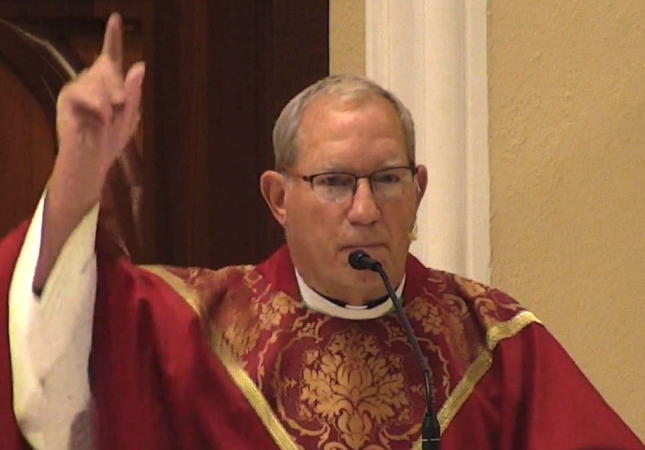
During First Friday Mass on Sept. 4, Bishop Robert Gruss challenged Catholics to examine where they place their sense of self, teaching that identity is not something people construct but something God reveals.
"We create an identity for ourselves," Bishop Gruss said, pointing to the many ways people quietly build a self-image out of comparison, approval, old wounds and self-protection.
Identities We Build for Ourselves
Bishop Gruss walked through the everyday patterns that shape a false sense of self. He named comparison — measuring up against others — approval-seeking, clinging to old habits and wounds, and self-protective walls built to keep others out.
He also pointed to the lies people repeat to themselves.
"I'm not good enough. I'm broken. I'm defined by my past," he said, naming three of the false narratives many carry for years.
"But we live those lies day in and day out," he told the congregation, adding that recognizing this simply means "you're human."
A Different Foundation
Turning to Scripture, Bishop Gruss drew on St. Paul's teaching that identity is not self-constructed but received from God. He noted that Paul described himself not by achievement or failure but as "servants of Christ and stewards of the mystery of God."
"Identity is not self-constructed," Bishop Gruss said. "It's received."
He explained that Paul refused to rely even on his own self-evaluation, trusting instead that the Lord alone judges him rightly.
"This is not fear. This is freedom," Bishop Gruss said, framing identity as something rooted in relationship rather than reputation.
New Wine, New Wineskins
Bishop Gruss connected his message to the day's Gospel, in which Jesus responds to the Pharisees' expectations with the parables of new patches on old cloaks and new wine in old wineskins.
"You cannot live a new identity with old patterns," he said, explaining that Christ's grace cannot be confined to rigid, unchanging hearts.
He said Jesus is not interested in patching up the old self.
"He's offering a new garment," Bishop Gruss said. "He's offering new wineskins."
Rather than an upgrade to the old self, he said, life in Christ is a full transformation — one built on self-surrender rather than self-construction.
Beloved Sons and Daughters
Bishop Gruss reminded those gathered of the identity given to every Catholic at baptism.
"You are His beloved son or His beloved daughter," he said. "That's it."
He acknowledged that over time, life's experiences can cause people to lose sight of that truth and build a different identity in its place. The invitation, he said, is to return to it.
"God sees you more truthfully and more mercifully than you see yourself," Bishop Gruss said.
An Invitation at the Eucharist
Bishop Gruss closed by inviting the congregation to surrender whatever they still cling to — old resentments, fears, or self-criticism — and to let Christ reshape them through the Mass itself.
"Today in this Eucharist, Jesus is offering you new wine," he said, "but He needs room to pour it."
He encouraged those present to surrender fully and allow that grace to take hold.
"Let Him transform your hearts through this very Eucharist," Bishop Gruss said.