On June 25, 2026, the Office of the Michigan Attorney General released its report concerning allegations of clergy sexual abuse within the Diocese of Saginaw. The investigation spans from 1950 to the present and examines allegations of sexual abuse by both diocesan priests and religious order priests who served in the diocese during this period.
The Diocese of Saginaw, like all Dioceses in Michigan, has cooperated fully with the Attorney General’s Office from the beginning of and throughout this investigation. We fully believe in greater accountability and transparency, which is essential in restoring the trust that has been broken resulting from the misconduct of a few.
Bishop Gruss' message to the faithful
Follow this link to Bishop Gruss' letter of response to the report
Listen to Bishop Gruss' news conference with his response the the AG report. (6-25-2026)
Key Findings
•The investigation into the Diocese of Saginaw did not reveal any allegations of the sexual abuse of a minor regarding priests in active ministry. No criminal charges resulted from this investigation.
•Every diocese in the State of Michigan has been involved in this investigation. The Diocese of Saginaw is the sixth of seven reports released by the Attorney General. It’s important to note that at every step of the process, the Diocese of Saginaw, like all the other Dioceses in Michigan, have fully cooperated with the AG office since launching its investigation in 2018.
•The Attorney General’s Office explains in its opening of the report, “The allegations are summarized here, and their inclusion does not reflect a determination by the Department that the allegations are credible or otherwise substantiated or indicative of a crime” (pg. 5).
•The report also states, “there is no indication that the Diocese has violated Michigan’s reporting obligations to report the sexual abuse of minors...” (pg. 7)
•During the 75-year period in the report, more than 680 priests served in our diocese. The report details the reported abuse by 37 priests and one deacon.
•For the 37 priests and one deacon, 30 are known or presumed to be dead. For the 8 who are living or presumed to be living, none are in active ministry.
•For the 37 priests and one deacon, other than a few entries, the conduct as alleged that may have violated Michigan criminal law all occurred before 2002, the year of the U.S. Bishops’ Charter.
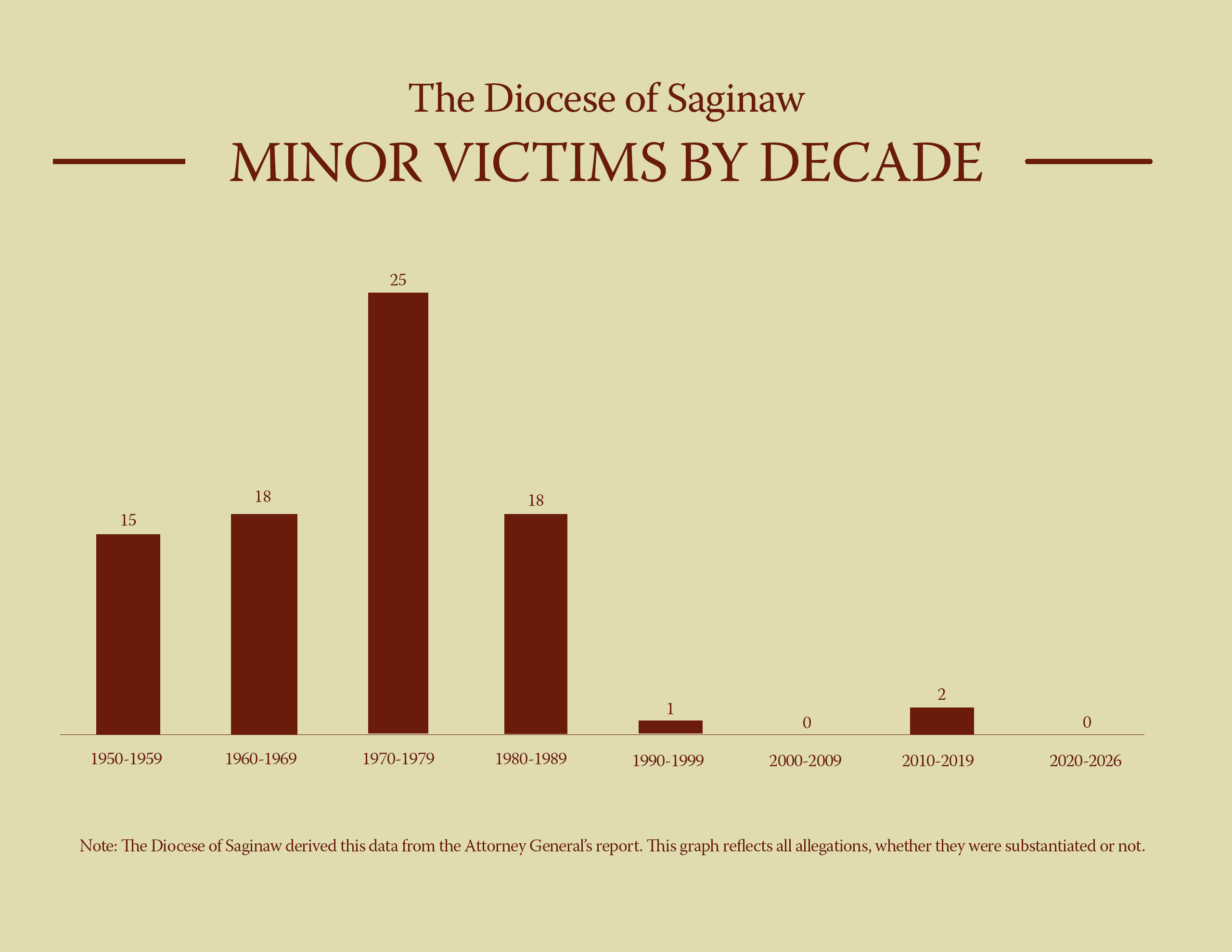
•The vast majority of reported abuse cases in our diocese are very old, with most occurring in the 1970s and 1980s.
•The alleged sexual misconduct of four priests is only related to adults (18 years or older).
• Overall, as stated earlier, this report did not result in any new criminal charges against priests in the Diocese of Saginaw. Additionally, the majority of allegations involving minors continue to relate to conduct that occurred prior to 2002, reflecting the impact of ongoing Safe Environment efforts and increased awareness, reporting, and preventive measures.
Follow this link to read the full report
For more information, contact the Diocesan Communications Office at 989-797-6630 or email communications@diosag.org
“We must remain vigilant and continue to do all we can to both prevent future abuse and support victim-survivors,” Bishop Gruss wrote in a 2022 letter. “Through ongoing education, we strive to create and maintain safe environments for our children, youth and vulnerable adults.”
PROMISE TO PROTECT








Q & A
- When and why did the Attorney General's investigation begin?
According to the report: “On Sept. 21, 2018, the Michigan Department of Attorney General (AG), in partnership with the Michigan State Police (MSP), launched an investigation into clergy sexual abuse throughout the State of Michigan, focusing on the seven Dioceses of Michigan’s Catholic Church. One purpose of the investigation was to investigate whether criminal charges could be filed against those who allegedly engaged in potentially criminal conduct or those who failed to comply with a statutory obligation to report conduct involving minors. The other purpose of the investigation was to determine if the Archdiocese and the Dioceses were complying with their statutory obligation to report sexual abuse of minors.
“On Oct. 3, 2018, a search warrant was simultaneously executed on the Archdiocese and all six dioceses in order to seize any information and records each diocese had regarding reports of sexual abuse...It (the searches) lasted 8 hours and more than 220 boxes of documents were seized. In total, an estimated 1.5 million paper documents were seized.”
- Has the Diocese of Saginaw cooperated with the investigation?
Yes. Since the Michigan Department of Attorney General’s investigation began, the Diocese of Saginaw has turned over all requested documents and immediately reported any new allegations of sexual abuse or misconduct involving clergy to the Attorney General’s Office. The Attorney General’s report summary states: “All seven Dioceses have cooperated with the AG’s investigation.”
- Are the allegations in the report either credible or substantiated?
Not necessarily. The Attorney General’s report states, “The allegations are summarized here, and their inclusion does not reflect a determination by the Department that the allegations are credible or otherwise substantiated nor indicative of a crime.”
- What is the difference between a credible allegation and a substantiated allegation?
A credible allegation is an allegation with a “semblance of truth,” meaning it appears to be or could possibly be true. There is a presumption of innocence until and unless an individual is proven guilty. In comparison, a substantiated allegation is an allegation that is supported by sufficient evidence establishing reasonable grounds to believe that the abuse occurred.
- What is the difference between inconclusive, unsubstantiated and non-credible allegation?
An inconclusive allegation has been investigated by competent authorities, but the evidence does not indicate whether or not the allegation is true. This may be the result of an investigation with either little or with conflicting information.
An unsubstantiated allegation has been investigated by competent authorities and the resulting evidence does not corroborate it. An unsubstantiated allegation may be the conclusion of an investigation in which the evidence does not appear to show it to be true.
A non-credible allegation is determined on basic information not to have a semblance of truth, meaning it appears implausible to have occurred. For example, an allegation may be determined to be non-credible if the individual was not serving or present at the time the abuse was alleged to have taken place.
Related Stories
Updated Safe Environment training aims to protect the vulnerable and empower the faithful
When a parish volunteer signs up to chaperone a field trip or serve at a youth event, Safe Environment training can seem like another box to check. However, the recently updated training, now expanded far beyond its original focus on child sexual abuse, has a much deeper purpose. It aims to equip ordinary Catholics to recognize warning signs, intervene early and help protect children, teens and vulnerable adults in every part of their lives.